 Grammar Spy
ESL Grammar Activities for Middle and High School
Practice a pattern, explain a correction, then use it in your own sentence. Three classroom activities for sheltered and mixed-level secondary ESL classes.
A shared task, flexible language support
Use these activities in middle and high school ESL classes, including sheltered instruction and mixed-level groups. Keep the grammar goal shared; offer a word bank or oral rehearsal before independent writing, and ask students ready for more to explain their choices.
For proficiency-focused planning, see ELD grammar activities. Extend the routine with grammar bell ringers for ELLs, or explore ESL grammar games for high school. The secondary ESL grammar practice library labels each resource’s access and included materials.
Choose today’s grammar focus
Adjust the suggested times to allow for rehearsal and writing.
ESL grammar bell ringer: fix the school-day sentences
Suggested 5–7 minutes · Goal: match a present simple verb to its subject.
Student directions
- Read each sentence and underline the subject.
- Rewrite the sentence with the correct verb.
- Compare with a partner. Explain why you changed the verb before checking the answers.
Worked model
Maya walk to school. → Maya walks to school.
Maya is one person, so the present simple affirmative verb takes -s.
Your turn
- My brother play soccer after school.
- They walks to class together.
- She do her homework after dinner.
Check bell-ringer answers and explanations
- My brother plays soccer after school. “My brother” is singular, so use plays.
- They walk to class together. With they, use the base form walk.
- She does her homework after dinner. The present simple form of do with she is does.
Say it, then write it
Rehearse one true routine sentence, then write it using “After school, ___.” Choose I, a friend’s name or they as your subject and check the verb.
Next step: use the free Case File #007 subject-verb agreement worksheet for further find-and-fix practice with an answer key. For a repeatable opening routine, see bell-ringer ideas with language support.
ESL past tense activity: reconstruct yesterday
Suggested 8–10 minutes · Goal: form simple past statements, negatives and questions.
Student directions
- Read the worked model. Notice the past-time word yesterday.
- Complete each sentence with the correct form of the verb in brackets.
- Compare answers with a partner. Circle did or did not where it appears and check the verb after it.
Worked model
Yesterday, I go to the library. → Yesterday, I went to the library.
Went is the irregular simple past form of go in an affirmative statement.
Your turn
- Last night, we (watch) a movie.
- Maya did not (finish) her project yesterday.
- Did you (see) the message?
Check past-tense answers and explanations
- Last night, we watched a movie. Watch is regular, so add -ed for the simple past affirmative.
- Maya did not finish her project yesterday. Did already marks the past, so the verb after did not stays in its base form finish.
- Did you see the message? After did in a question, use the base form see, not saw.
Compare yesterday, then write
Tell a partner two statements about yesterday and compare what you did. Write two sentences using “Yesterday, I ___.” and “I did not ___.” A fictional day is also fine.
Next step: explore past-tense activities for ESL students. When students are ready to contrast completed actions with actions in progress, use the free Past Simple vs. Past Continuous worksheet, with practice, a writing prompt and an answer key.
ESL grammar games for high school: explain your correction
Suggested 8–10 minutes · Goal: correct a verb form and explain your choice.
Student directions
- Read the model and notice the subject and verb.
- Correct the three sentences. Keep the original meaning.
- Choose one correction and explain it to a partner before revealing the answers.
Worked model
He don’t like the ending. → He doesn’t like the ending.
Use doesn’t with he in a present simple negative; like stays in the base form.
Your turn
- The students was ready.
- We didn’t went outside.
- She is write a message.
Check correction answers and explanations
- The students were ready. The plural subject students takes were, not was.
- We didn’t go outside. After didn’t, use the base form go because did already marks the past.
- She is writing a message. The present continuous uses is plus the -ing form writing.
Explain it, then use it
Say “I changed ___ to ___ because ___.” Then write a new sentence using the same pattern and explain your choice again.
Next step: open free interactive grammar practice and choose Error Smash for continued sentence-error practice. For a paper follow-up, the free Common Errors Detective Sheet provides sentences to correct and identify by error type. Browse the full public grammar games selection for other formats.
Printable follow-up activities
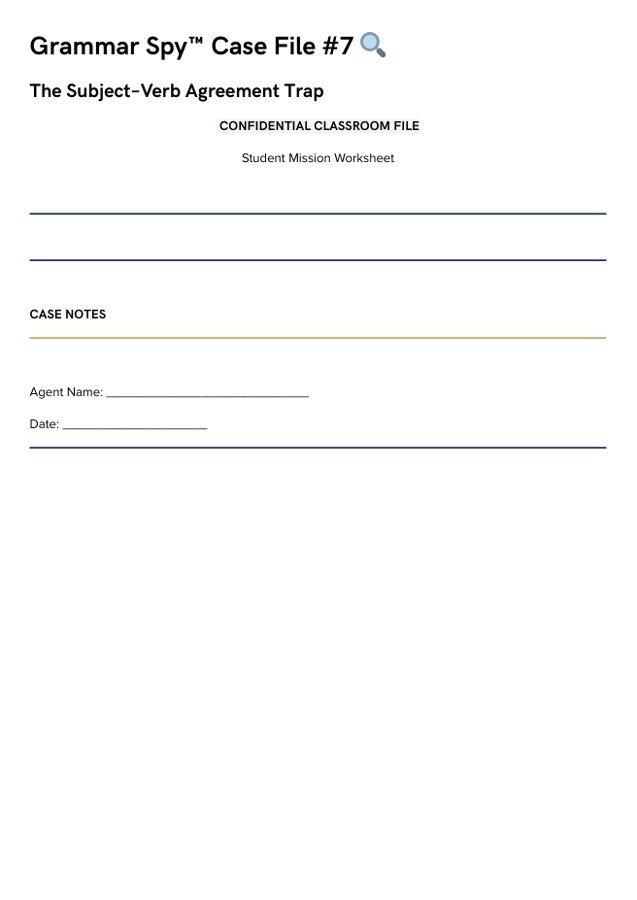
The examples above can be read directly from this page. For printable follow-up, the three linked resource pages provide free PDF downloads without an account or email.
Open the agreement worksheet and answer key. The past-tense worksheet adds a simple/continuous contrast; the detective sheet broadens the editing practice. Check each resource page for its exact contents.
Optional email delivery is separate from downloading.
Frequently Asked Questions
How can I adapt these activities for a mixed-level ESL class?
Keep the same sentences and grammar goal. Offer a word bank, the worked model and oral rehearsal before writing. Ask students ready for more to explain a correction and create a new example.
Should I reveal the answers before students compare?
Leave the answer panels closed while students try the items and explain a choice to a partner. Reveal them for checking, then ask students to apply the pattern in their own sentence.
Why do students use finish and see after did?
Did already marks the past in questions and negatives. The main verb therefore stays in its base form: did not finish and Did you see?
Do the linked games and free PDFs require student accounts?
The public browser games and the three free PDFs linked here can be opened without an account. Choose Error Smash on the interactive practice page; each printable’s resource page has a direct download.
Keep the next task focused
Choose a public game that matches today’s grammar pattern.
Popular Teaching Resources
Explore more grammar lessons, worksheets, and classroom activities from Grammar Spy.