 Grammar Spy
Monday: Is It a Sentence?
Sort: “The new student.” / “The new student found Room 214.” / “Because the bell rang.” Answer: only sentence 2 expresses a complete thought with subject and verb. Extension: repair 1 or 3.
FragmentsOne repeatable 8-minute routine, five meaningful prompts, and concise answer guidance for planning the opening week.
Students silently read the prompt and mark what they notice.
Students answer independently so you see what each learner can do.
Partners compare one choice using “I chose ___ because ___.”
Model the answer, name the pattern, and let students revise in a different color.
Sort: “The new student.” / “The new student found Room 214.” / “Because the bell rang.” Answer: only sentence 2 expresses a complete thought with subject and verb. Extension: repair 1 or 3.
FragmentsChoose: “The list of supplies is/are on the desk.” Answer: is. The subject is list; “of supplies” does not change the subject. ELL frame: “I chose ___ because the subject is ___.”
AgreementPunctuate: “Let’s eat agents.” Answer: “Let’s eat, agents.” Discuss how the comma shows direct address and prevents a very different meaning.
CommasImprove: “The thing was good.” Possible answer: “The illustrated schedule made the first day easier to follow.” Accept multiple precise revisions; ask what changed.
Word ChoiceCombine: “The hallway was crowded. I arrived on time.” Possible answer: “Although the hallway was crowded, I arrived on time.” Also accept “The hallway was crowded, but I arrived on time.”
CombiningFor each prompt, name only the pattern students need that day. A strong explanation is one or two sentences: identify the correct answer, point to the evidence, and model the repair. Save edge cases and terminology-heavy exceptions for a later lesson.
When multiple answers are possible, say so. On Thursday and Friday, judge whether the revision is grammatical and clearer—not whether it matches one exact sentence. That keeps the warm-up focused on reasoning rather than answer-key guessing.
Continue with ten more seasonal prompts or move into the complete bell-ringer hub.
The download is an 8-page PDF, and every page is shown or described here before you commit class time to it. Page 1 is the cover, page 2 is the one-page teacher guide, pages 3–7 are the five student day pages, and page 8 is the teacher key.
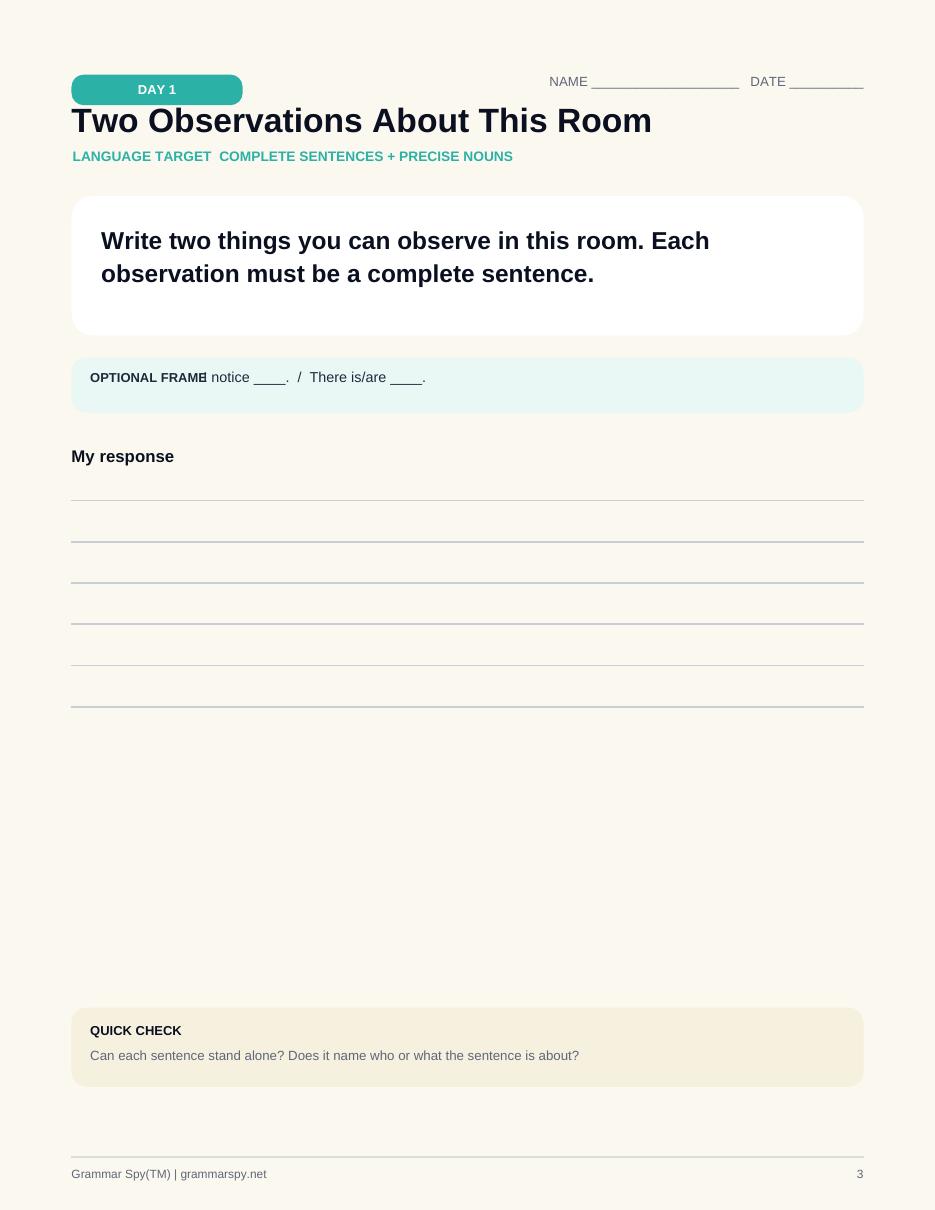
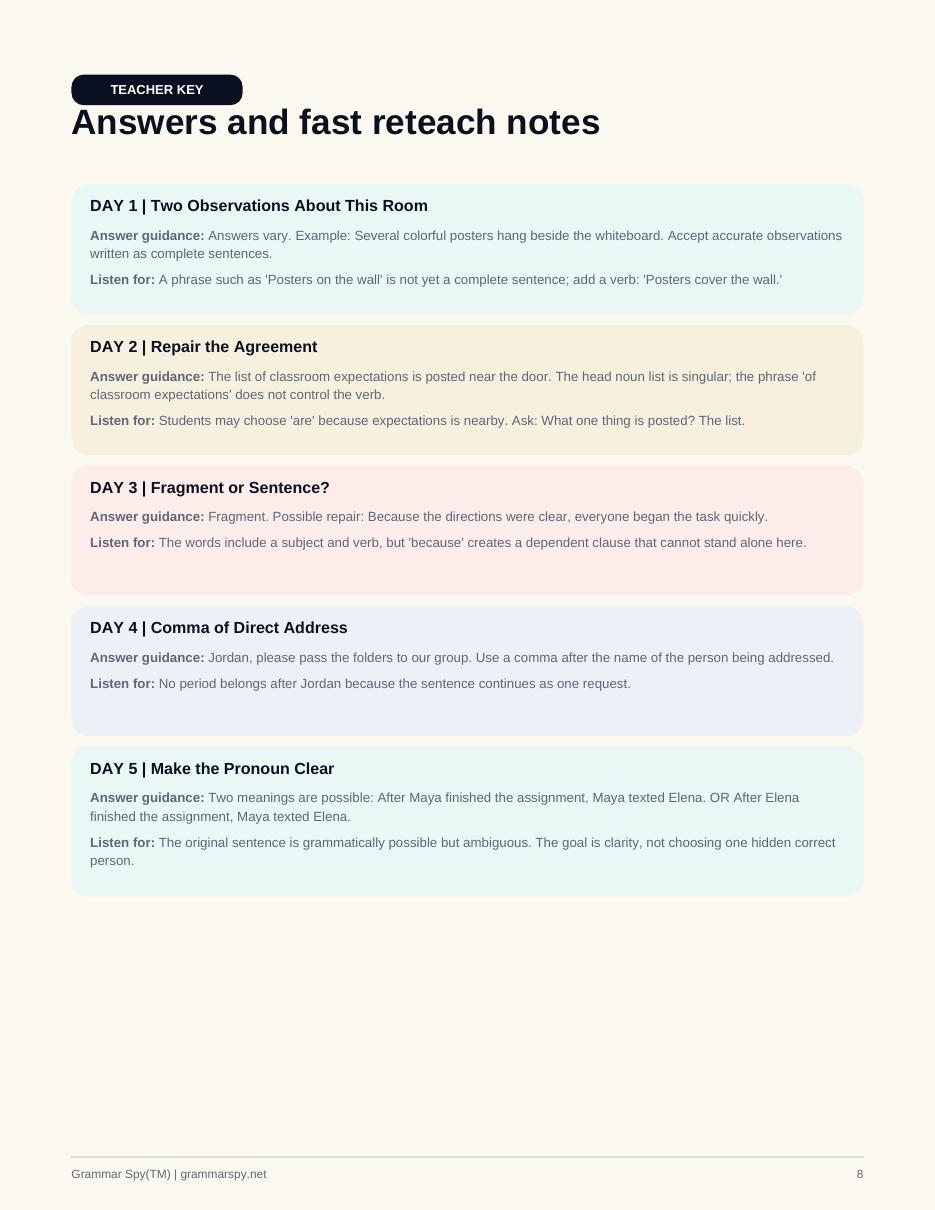
The five student pages are: Day 1 Two Observations About This Room (complete sentences and precise nouns), Day 2 Repair the Agreement, Day 3 Fragment or Sentence?, Day 4 Comma of Direct Address, and Day 5 Make the Pronoun Clear. Each page carries the language target, one prompt, an optional frame, response space, and a two-question quick check.
Prompts are deliberately low-risk: nothing asks a student to disclose anything personal, and students may invent a response whenever a prompt could feel private.
These are teacher decisions you make in the moment — the PDF does not change itself. Pick the route that matches the student in front of you.
Keep the thinking constant and vary only the language support. The debrief is the part that must not be cut: reveal one strong answer and one common misconception, every day.
Listening access should not depend on asking for help in front of peers.
“I chose ___ because ___” works across all five days and makes explanations possible.
Students can say the answer to a partner before writing; the grammar target stays the same.
Cross out, insert, and reread the corrected sentence so students see editing as a process.
The sampler is free forever. Teachers who want a full unit built on the same routine usually move to a Grammar Spy mystery unit on TPT.
Start with high-utility patterns that reveal broad needs: sentence completeness, subject–verb agreement, punctuation, precise word choice, and sentence combining.
Yes. The prompts are age-respectful for grades 6–12. Increase the explanation requirement for advanced students rather than changing the core prompt.
Accept any grammatical answer that meets the stated goal. Ask students to point to evidence or explain how their revision improves clarity.
A notebook, digital form, or weekly response sheet all work. The important part is preserving independent attempts and visible revisions so you can see patterns over time.
A predictable entry routine reduces transition time and starts language practice immediately.
These three free resources work in sequence: find the baseline, establish the routine, then apply grammar in a low-stakes challenge. The diagnostic is one instructional data point for planning — not a proficiency, placement, WIDA-level, or reclassification test.
Planning the whole week? Read the calm 5-day first-week ELD plan.
Explore more grammar lessons, worksheets, and classroom activities from Grammar Spy.